
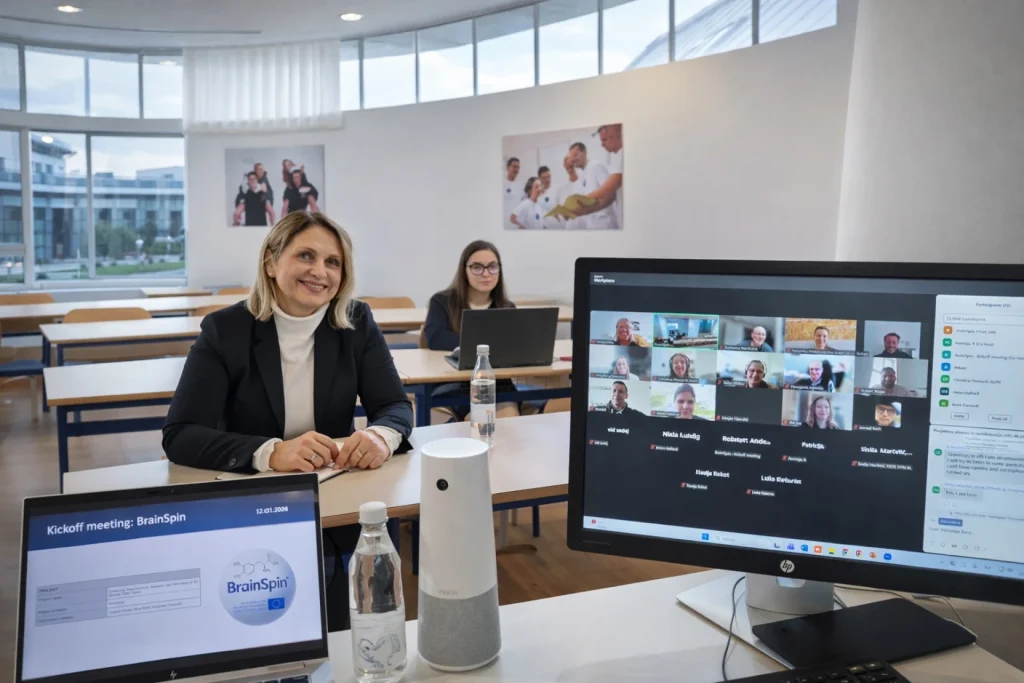
The Erasmus+ Sport project BrainSpin – Strengthening neuroplasticity, inclusion and the well-being of people with Parkinson’s disease through table tennis officially began with a hybrid (online) kick-off meeting, which took place on 12 January 2026 in Maribor.
BrainSpin is a 36-month international Erasmus+ Sport project that uses table tennis as an evidence-based rehabilitation and inclusive tool for people living with Parkinson’s disease. By connecting movement, cognitive, and social elements, the project contributes to improving mobility, cognitive functioning, quality of life, and long-term engagement in physical activity. One of the key goals of the project is the development of a standardized training framework and a “Train-the-Trainer” program, supported by a digital learning platform, which will enable sustainability, transferability, and broad accessibility of results across Europe.
The project is coordinated by Alma Mater Europaea University, and involves a strong and multidisciplinary consortium of eight partners from six European countries – Slovenia, Germany, Croatia, Italy, Bosnia and Herzegovina, and Greece. The consortium brings together universities, sports clubs, patient organizations, and civil society organizations:
- Alma Mater Europaea University (Slovenia)
- PingPongParkinson Deutschland e.V. (Germany)
- Table Tennis Club / Table Tennis Center Ronald Ređep (Croatia)
- NTK Škofije (Slovenia)
- C.S.D. ASK KRAS (Italy)
- Movement for the Brain Association – No Brain No Gain (Slovenia)
- Youth Table Tennis Club Spin (Bosnia and Herzegovina)
- Aristotle University of Thessaloniki (Greece)
At the introductory meeting, the partners aligned on the project goals, governance structure, work plan, and upcoming activities, thereby laying solid foundations for successful implementation of the project in all participating countries.
